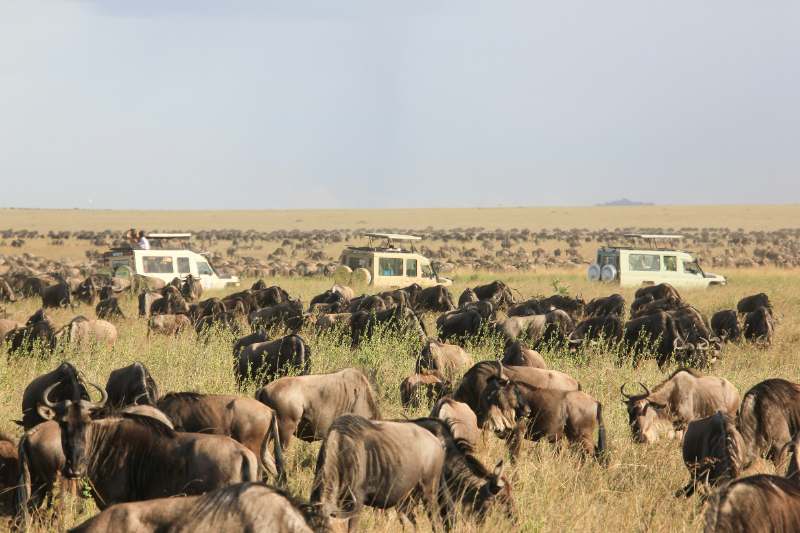
It is the largest overland migration of animals on the planet.
It is the largest overland migration of animals on the planet. Roughly 1.5 million wildebeest, 400,000 zebra, and 200,000 Thomson's gazelle move in an endless loop between the Serengeti in Tanzania and Kenya's Maasai Mara, driven not by instinct alone, but by the ancient pull of rain and fresh grass. Witnessing the Great Migration is, for many travellers, a once-in-a-lifetime ambition. This guide will help you do it right.
1. Understanding the Migration Cycle
The Great Wildebeest Migration is not a single event, it is a continuous circular journey covering approximately 800 kilometres every year. The herd never stops; it simply follows the rains.
2. The River Crossing: Kenya's Greatest Wildlife Spectacle
Of all the migration's moments, none rivals the Mara River crossing. Pushed by the herd behind them and drawn by the greener grass ahead, thousands of wildebeest plunge into a crocodile-filled river in scenes of spectacular, terrifying drama.
Crossings are not predictable. The herd can mass at the bank for hours before a single animal takes the first step, and once they start, it is over in minutes. Patience is the defining skill. Safari Yetu's guides monitor multiple crossing points and communicate in real time so your vehicle is positioned ahead of the action, not arriving after it.
3. What to Expect on a Migration Safari
The Sound
Before you see the migration, you hear it. The low, constant grunt of thousands of wildebeest, a sound that carries for kilometres across the plains. At close range, it is one of the most visceral, prehistoric sounds in nature.
The Scale
Numbers like 1.5 million are hard to visualise. On the ground, in the Mara, you understand them differently, as a line of animals that extends beyond the horizon in both directions, moving like a slow river of fur and dust.
The Predators
The migration brings Kenya's predators to their peak activity. Lion prides coordinate complex hunts. Cheetahs isolate individuals from the mass. Spotted hyenas follow the herd in large clans. Nile crocodiles, some exceeding 5 metres, station themselves at every crossing point.
4. Choosing Your Base
Mara Triangle camps: Best for crossings; fewer vehicles; premium pricing
Olare Motorogi / Naboisho conservancy camps: Off-road driving, night drives, walking safaris, exclusive access unavailable in the main reserve
Talek / Sekenani side camps: More affordable; strong game but busier at crossings
Fly-in options: Charter from Nairobi (Wilson Airport) to Mara airstrips, saves the road drive and maximises time in the field
5. Photography During the Migration
Migration season is Kenya's most photographically rewarding period. For river crossings, a telephoto lens of at least 300mm is essential, you will be positioned at a respectful distance from the bank. For wide herd shots, a 24-70mm captures the scale. Golden hour on the open plains with the herd in the background is one of wildlife photography's iconic frames.
Safari Yetu offers dedicated photography safari options with extended morning light positioning and vehicles adapted for camera setups.
6. Practical Information
7. Common Myths About the Migration
Myth: You can predict the exact date crossings will happen. You cannot. The herd responds to grass growth, which responds to rainfall, both of which are variable. What expert guides can do is read the herd's behaviour and positioning, and make educated predictions within a window of hours.
Myth: You need to go to Tanzania to see the migration. Tanzania offers calving season (January-February) and the Grumeti River crossings (June-July), but the Mara River crossings in Kenya (July-October) are generally considered the most dramatic. Both countries offer different chapters of the same story.
Myth: The migration only happens once a year. The herd crosses the Mara River multiple times, in both directions, over the course of several weeks. During peak season, crossing events can occur almost daily.
Planning Your Migration Safari
Migration safaris require booking 6-12 months in advance for peak season (August-September). Accommodation and vehicle availability is limited during the highest-demand period. Safari Yetu offers a range of migration-timed packages from 3-night introductions to 7-night comprehensive experiences.
Our migration season guides have spent over a decade positioning vehicles for the best river crossing views across the Mara.